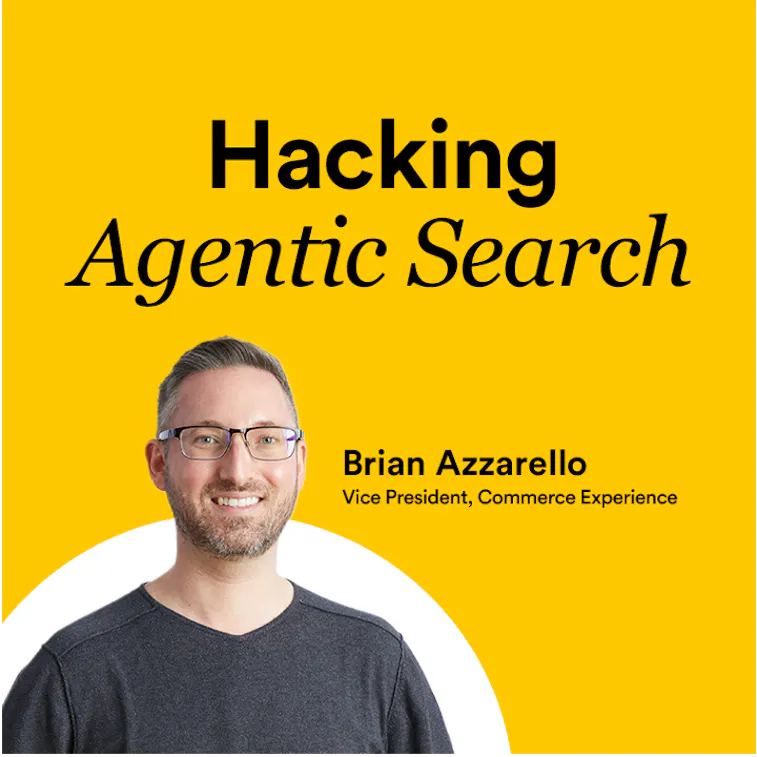
Commerce marketers have spent significant time and money over the last 25 years strategizing their way to the coveted top of the search engine results page (SERP). And for good reason: Backlinko's analysis of 4 million search results on Google found that the top three organic results capture 54.4% of all clicks.
But as shoppers increasingly turn to AI assistants, brands face a new yet similar challenge and must again crack the code on getting included in the recommendations of large language model (LLM) chatbots — which can often only contain a single product recommendation.
While there is some parity with how traditional search engines position brands within the SERP, LLMs are unique and require innovative content strategies to maximize brand visibility.
The new shelf is a sentence
In agentic search, your brand doesn't get a row of blue links to compete against. It gets included in one sentence in a recommendation — or it doesn't get mentioned at all.
The good news: the agents aren't pulling that sentence out of thin air. They're largely synthesizing it from four content sources that brands can influence if they devote time and resources to these critical spaces:
1. Digital Publishers
Food & Wine, Martha Stewart, category-specific blogs, advertorials — the same publishers that used to generate organic site traffic are now feeding the agents. PR and earned media just gained a second life, although the playbook is different. It's now less about a clip in a magazine and more about consistent, recent, high-quality coverage the bots can find and trust. Expect “agent relations” to start sitting next to PR and investor relations on the org chart.
2. Social Networks
Agents scrape what they can see. That means open, public social content is doing disproportionate work in shaping agent recommendations (Reddit above all, as it turns out). Private accounts and walled gardens are largely invisible. The implication: creator strategies should move beyond reach to also focus on seeding authentic, public conversations — across macro voices, micro creators, and the everyday reviewers whose threads agents are quietly reading.
3. Brand Sites
Let’s be honest: For years, brand.com has been the place nobody visited. But that’s changed because agents go there. They read your product catalog, your descriptions, your syndicated reviews from Bazaarvoice or PowerReviews. If your site’s content is thin, outdated, or missing reviews, you're handing the recommendation to a competitor whose site is better prepared.
4. Retailer Sites
Your product detail pages are now training data, too. Titles, keywords, attributes, imagery, and ratings all feed the recommendation. Fresh, complete, optimized content on every retailer where you sell isn't a “nice to have,” it's a prerequisite for being mentioned at all.
A simple way to start: audit, activate, analyze
Getting started doesn’t require a new tech stack, just a repeatable loop of three steps.
1. Audit. Start by asking the agents themselves. Run the queries your shoppers would run and see what comes back. Where does your brand show up? Where does the competition show up instead? Then, walk through the four sources and find the gaps. Is it weak PR, quiet social, an undernourished brand site, or a retailer catalog that's gone stale?
2. Activate. Close the gaps in the order that matters most. That might mean a sponsored editorial push, a creator program built for social platforms, a brand-site refresh with syndicated reviews, or a sweep of every PDP. Act first on the source where you're weakest, not the one that's easiest. Here is an action plan for each content source:
Digital Publishers
· Establish a public relations strategy with key media outlets to maximize news coverage.
· Invest in paid partnerships and advertorials for guaranteed placements.
Social Networks
· Regularly publish content and engage with shoppers across social networks, with a specific focus on Reddit.
· Develop creator/influencer strategies to maintain positive social commentary and steady content pipeline across social networks.
Brand Sites
· Ensure all SKUs are accessible on your site with tile content, product descriptions, features and benefits, ingredients, reviews, etc.
· Include and maintain a section for press releases that note new item launches, product changes and reformulations, etc.
Retailer Sites
· Ensure the content (tile images and copy) for each of your PDPs is optimized rigorously and updated regularly.
· Develop a ratings and reviews strategy and ensure all reviews are syndicated across retailer sites.
3. Analyze. Come back to those same agent queries 60 to 90 days later. Did the recommendation change? Did your brand move up, get mentioned, get described differently? These signals won't be perfect, but they will be directional — and directional is enough to help you keep optimizing.
The honest assessment
The hardest question to answer isn't what to do. It's how to scale your activity cross every category, every retailer, every market, every agent. That answer is still being written. But the brands that start this work now instead of waiting for a more perfect playbook will get themselves discovered by agents while everyone else is still scrambling to catch on.